Home

The weeks and days that led up to our trip to the U.S. and Canada were flooded with thought and speculation about how it was going to feel to be back home. The ebbs and flows of excitement, curiosity, and trepidation flowed through our bodies like ocean swells. By the time we arrived in L.A., we were ecstatic.

While driving down California’s Santa Ana Freeway, we fervently looking out the car windows at garish billboards for law offices and car dealerships, oversized storefronts for Home Depot and Wal-Mart, and long, lingering lines at Taco Bell, In-N-Out Burger, and Starbucks. It was exciting and comforting to see everything familiar!

While sitting back and unwinding in our seats, we had the sudden and unexpected feeling that we hadn’t even left. It felt like we were still living in Arizona. It felt like we were on vacation and preparing to make our annual pilgrimage home to see our families. It felt like the past twenty-two months in Indonesia didn’t exist. How illogical and startling is that?

As absurd as it seemed, we continued vacationing like nothing had changed. We spent time seeking out thrill rides in California Adventure and stuffing our faces with blue and pink cotton candy in Disneyland. We traversed vast, fertile prairielands along Idaho, Utah, and Montana’s highways to visit parents, brothers, sisters, aunts, uncles, and cousins. We rode horses in the shadows of the Rocky Mountains. And, we shopped until our suitcases were packed full.

The reality of living 7,693 miles away didn’t hit us until the girls and I parted ways with Chris in the Salt Lake City airport, when he started his journey back to Indonesia and we flew north to visit my family in Canada. Just as he stood up to find his gate, flashbacks of jobsite leaped into our minds; promptly reminding us of our life created and defined by a small copper town in the middle of the Papuan rainforest. A life waiting for our return.

Disneyland and California Adventure
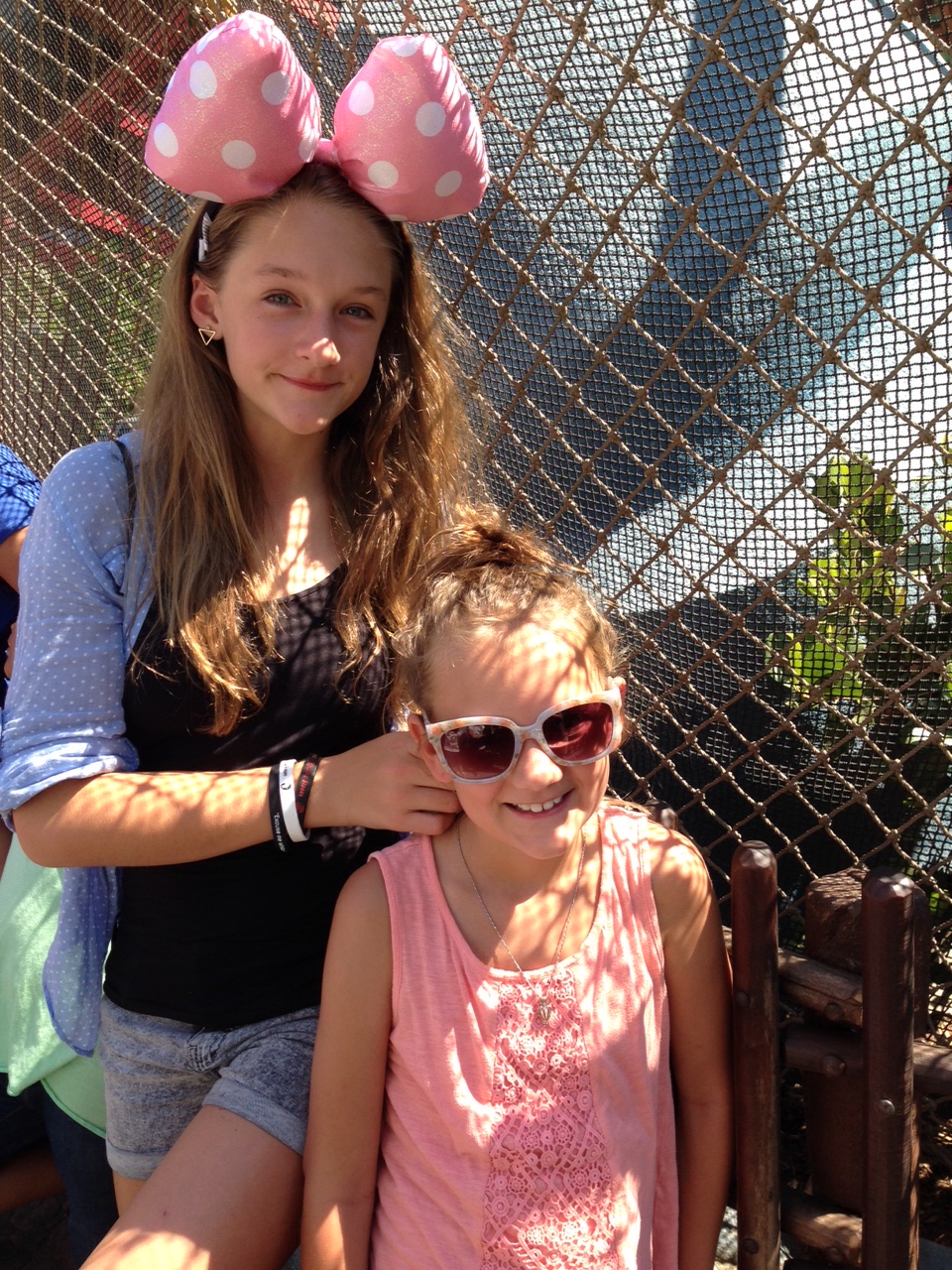
Ally and Kylee

Ally and Kylee waiting in a very long line at California Adventure.

Ally and Kylee, and their cousins Anya and Alex, waiting in line to ride

Ally and Kylee, their cousins, Anya and Alex, waiting in another very long line at California Adventure.
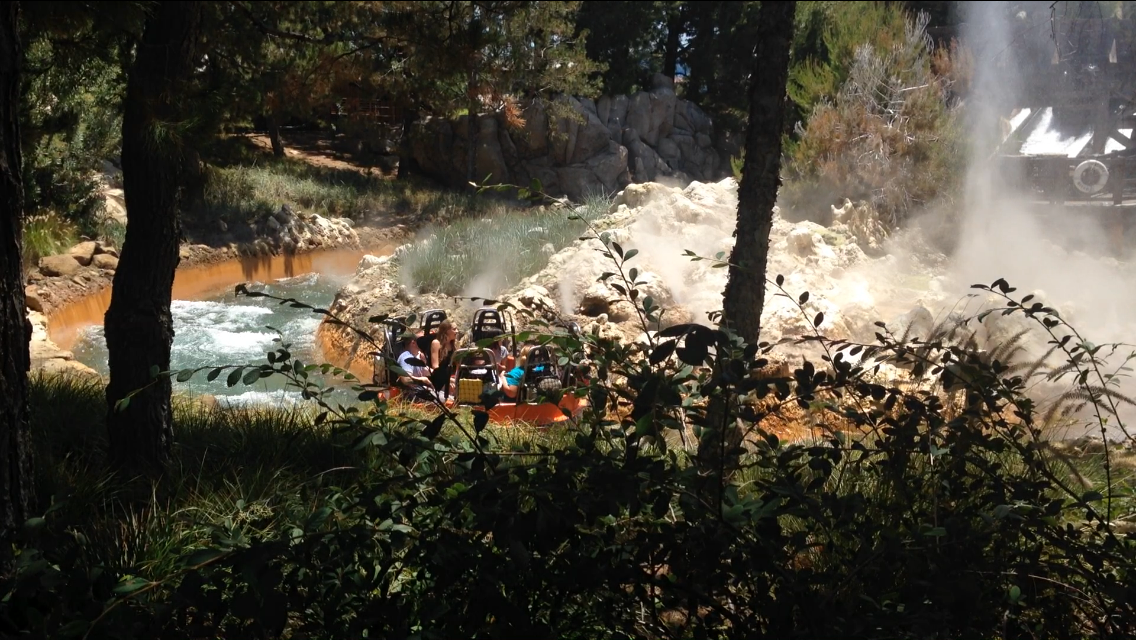
The girls and their cousins coming down Splash Mountain.

The girls and their cousins rounding the corner at Splash Mountain.

Chris, Kylee, Alex, and Chris's sister, Wendy, waiting to begin their Tower of Terror ride.

Chris, Kylee, Alex, and Chris’s sister, Wendy, anxiously waiting to be visciously launched up and down the Tower of Terror.

Salt Lake City, Utah

Kylee was sick the entire time we were in Salt Lake City, visiting her Aunt Jen and Uncle Chris. Fortunately, Chris and Ally were able to spend time with them. This is a picture of Chris, her sister, Jen, and Ally going down the alpine slide in Park City.

Kylee was sick the entire time we were in Salt Lake City. Fortunately, Chris and Ally were able to spend some quality time with his sister, Jen, and her husband, Chris. This is a picture of Chris, his sister, Jen, and Ally posing for a picture before going down the alpine slide in Park City.

Idaho Falls, Idaho

Chris's mom and and dad own an average near Bone Idaho. It was a spot where we would go camping as often as we could. Make a day trip up to see it and have dinner.

Chris’s mom and and dad own an acreage near Bone, Idaho. It’s a spot where we have spent a lot of time camping with his family. While we were in Idaho, we took a day trip to the property to relax, enjoy the trees, and eat a Dutch Oven dinner (bliss!).
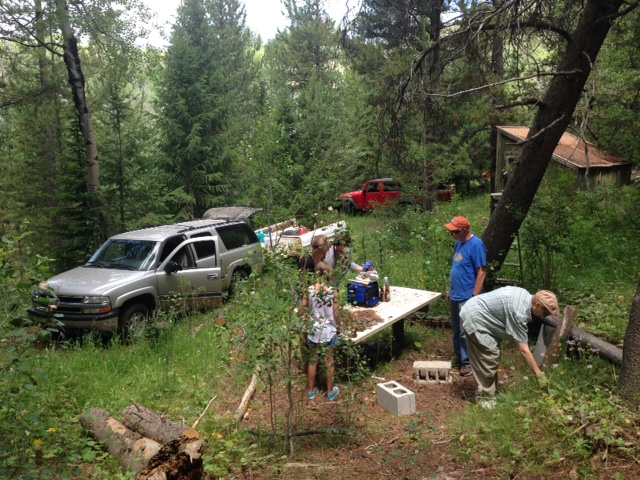
Cleaning the site and preparing for a day of Dutch Oven cooking and relaxation.

Chris, the girls, and me helping Grandpa Dave and Grandma Kaye clean the site for the day’s activities.
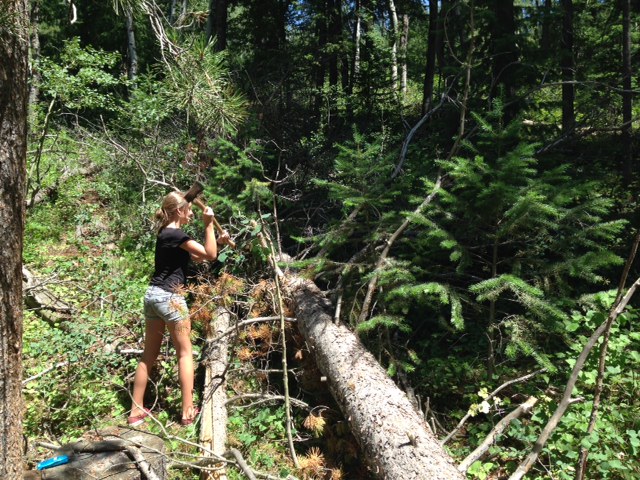
Ally cutting firewood for our campfire.

Ally using Grandpa’s axe to cut firewood for the campfire. Like mother like daughter!
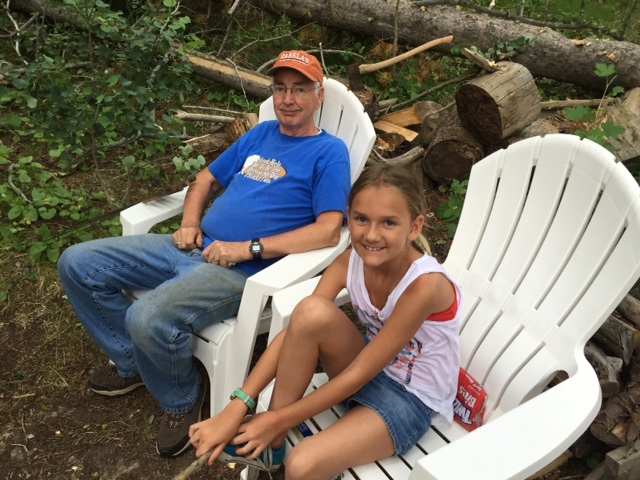
Kylee and Grandpa Dave enjoying the campfire.

Kylee and Grandpa Dave enjoying the campfire.

Ally and her cousin, Katelyn, playing on Grandpa Dave's tractor.

Ally and her cousin, Katelyn, playing on Grandpa Dave’s tractor.

Alberta, Canada
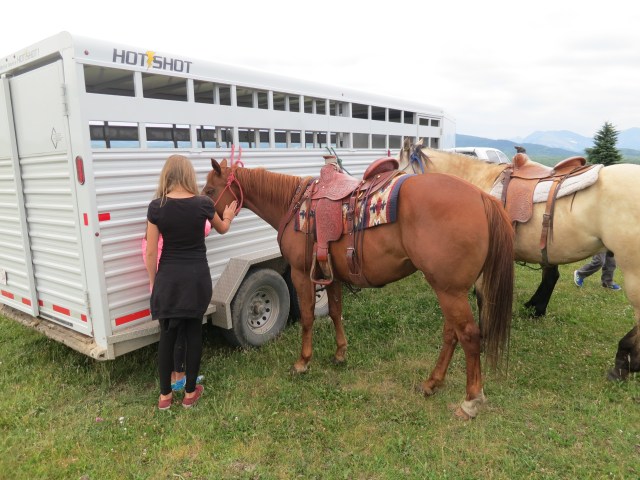
One of the highlights of our trip home was riding horses in the foothills of the Rockies. My Aunt Shellee, and two of her girls, Kari and Brandi, organized a day of horseback riding, ATV riding, and a Dutch Oven lunch (bliss times two) at their ranch in Mountain View (aptly and perfectly named by the community's stunning views of the Rocky Mountains).

The highlight of our trip home was riding horses in the front yard of Waterton National Park. My Aunt Shellee, and two of her girls, Kerri and Brandi, organized a day of horseback riding, ATV riding, and a Dutch Oven lunch (bliss times two!) at their ranch in Mountain View. The perfect day ended with Kerri’s homemade strawberry shortcake – made with fresh strawberries from a nearby Hutterite colony!
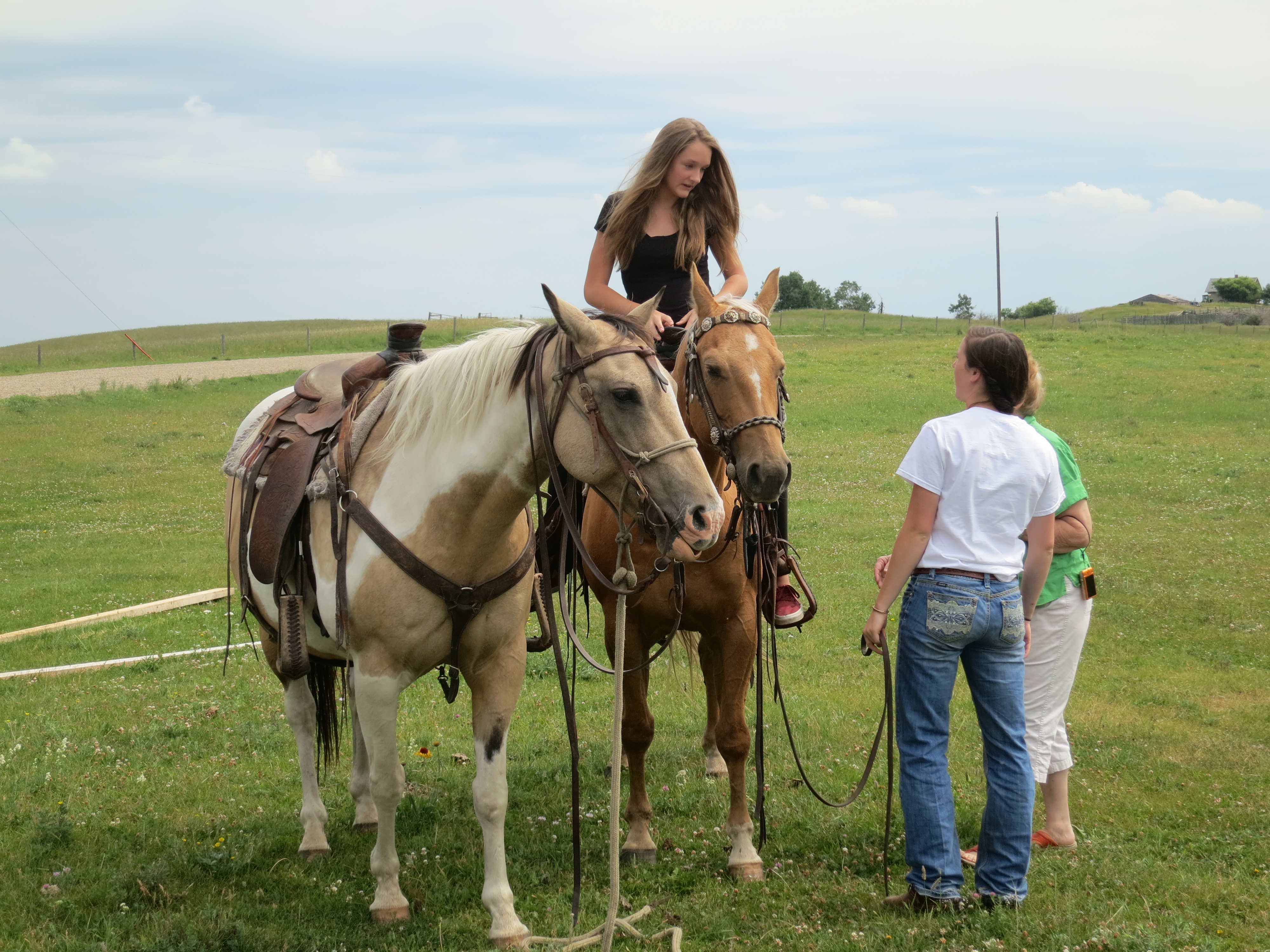
Ally getting on her horse, with the help of kari's daughter,

Ally making friends with her horse, with the help of Grandma McNabb and Kerri’s daughter, Bailey.
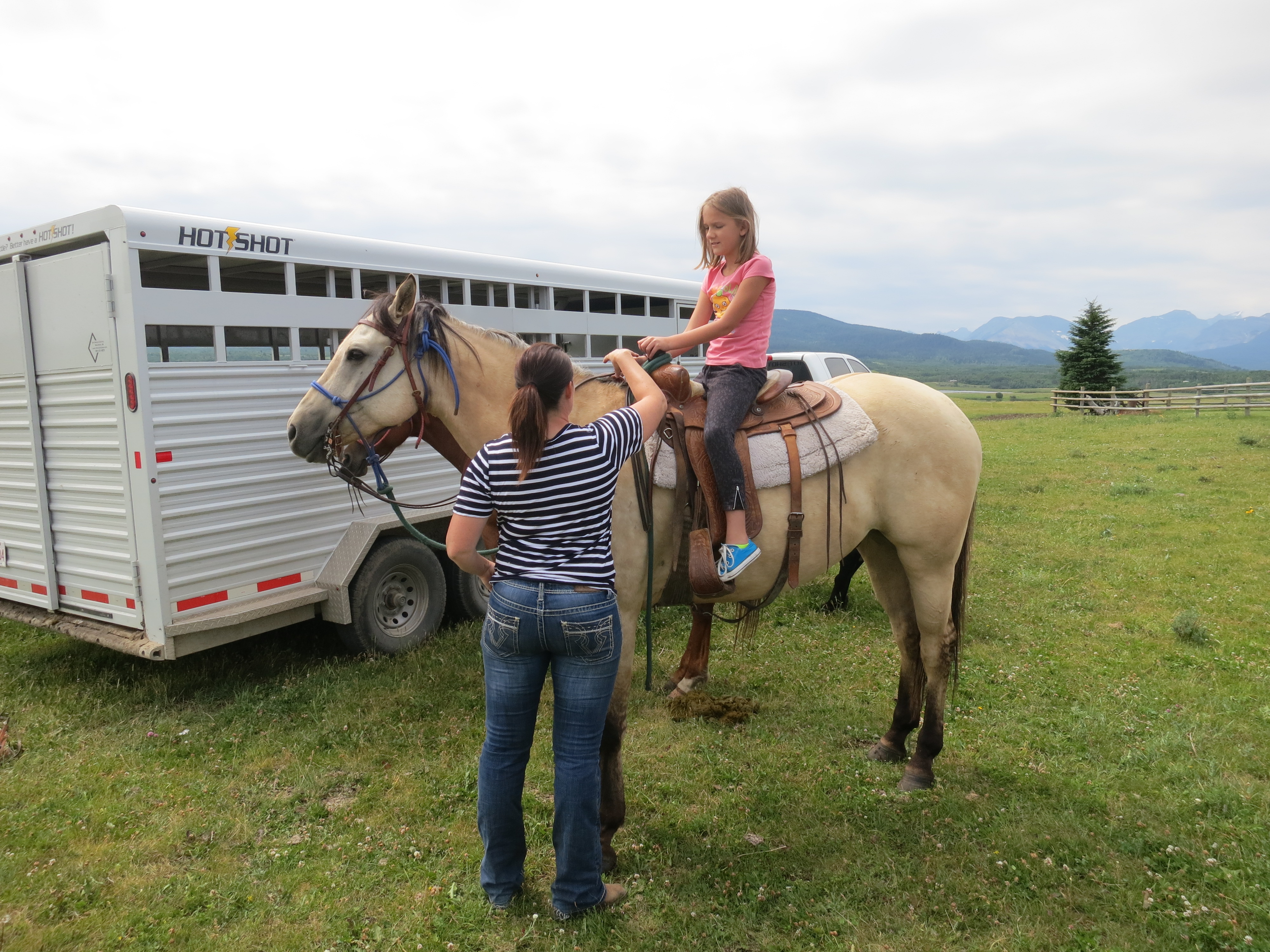
Kylee on her horse.

Kylee on her horse, receiving instructions from my cousin, Kerri, on how to use the reigns.

The group heading off on their ride.

Led by my Aunt Shellee, the group of sisters, brothers, and cousins set off on their ride along Payne Lake.

Cowgirls

Cowgirls in the making!

Group photo after their return.

A group photo of the riders – Kylee, Bailey, Ty, Kerri, Aaron, Ally, Shellee, Derek, Parker, and Brandi (with her young daughter).

My mom, aunt, cousins, sister-in-law, and me starting out on our ride. I am in the back.

My mom, aunt, two cousins, sister-in-law, and me starting out on our ride. My mom (in the green shirt) is riding the last living decedent of the horse that was given to her by her father.

With another great vacation behind us, we are now back at jobsite preparing for a short trip to Australia before the beginning of the 2015/2016 school year.

Posted in Ally Rose, Kylee Rose, Vacation | Tagged , , , , , , , , , , , , , , | 6 Comments

We’re on Vacation!

Sorry-out-to-live-be-back-soon

I’ll be back in a month to post more pictures and stories of our family’s adventures in Indonesia (and beyond)!

Posted in Uncategorized | Leave a comment

6 Kilometers Underground

PTFI has several of the fastest growing underground mines in the industry. In 2017, when GBC (Grasberg Block Cave) begins production, it will be the largest underground hard rock mine in the world, and PTFI’s collection of GBC, DOZ (Deep Ore Zone), DMLZ (Deep Mill Level Zone), and Big Gossan will make up the largest underground mining complex in history. Technologically advanced systems of remote-operated and autonomous machines will control loaders, ore chutes, rock breakers, and train ore haulage systems around a labyrinth of tunnels to pull about 240,000 metric tons of ore from the mountain every day. It will be a sight to see!

Even today, the functions of PTFI’s underground mines are a remarkable display of mining prowess. Chris took Ally on a tour of two of the mines that are being developed, DMLZ and GBC, last Saturday morning.  Between these two mines, PTFI develops well over a kilometer of new tunnel each week.  Traveling six kilometers back into the deep, dark bowels of the Sudirman Mountain Range was an overwhelming and intimidating experience for Ally, but it is one that she will never forget.

A picture that Ally took of the underground portholes from Chris's office.

A picture that Ally took of the underground portals from Chris’s office.  These lead to DMLZ, Big Gossan, and GBC, which will set records for sophistication and production.  The adjacent waterfall, the surrounding rainforest, and the incredible terrain also make them some of the most beautiful mining portals on the planet.

Ally standing in front of Chris's parked vehicle.

After entering a portal and driving along several miles of underground road, Chris parked his vehicle, so they could get out and explore the area by foot. Ally loved how she could feel the penetrating vibrations of loud, moving trucks and loaders in the walls and the ground that surrounded her.

Write

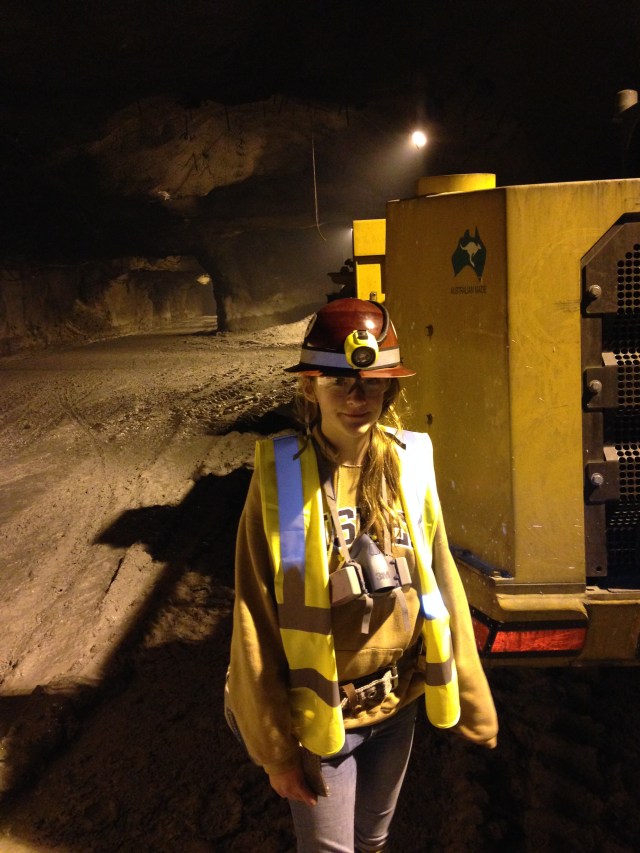
Chris and Ally dressed in full underground gear – hard hats with cap lamps, safety vests, safety glasses, earplugs, respirators (strapped around their necks), self-contained self rescuers (strapped around their waists), and steel-toed boots.

write

The expression in Ally’s eyes describes her experience of going underground  – “Holy Crap!” In this photo, a large loader was quickly making its way towards her. She thought she was its target; Chris knew it was turning to her left down another tunnel.

Ally standing near the loader after it stopped and parked.

Ally standing near the loader after it stopped and parked. She was hoping to get a picture standing next to an explosives truck, but they didn’t stop when she and Chris were there.

Another picture of Ally near the loader.

Ally standing near the front of a specialized mining machine with a web of tunnels behind her.

Before they went underground, they had to check in using a tracking system, so the mine rescue team knew to look for them if there was an emergency. Ally was relieved when she checked out after the tour.

Before anyone goes underground, they have to check in using a tracking system, so the mine rescue team knows who to look for  if there is an emergency. Ally was relieved when she checked out and was back on the surface, but was disappointed that the tour was over.

Posted in Ally Rose, Tembagapura | Tagged , , , , , , , | 5 Comments

Pogapa Village

Deep in the interior of the Irian Jaya mountain range sits a remote village that is only accessible by foot and plane. A maze of rugged jungle trails allows villagers to trek from one village to another village, which often requires arduous, multiple day journeys. Getting anywhere else requires travel by bush plane. Pogapa is as remote as it gets without falling off the map.

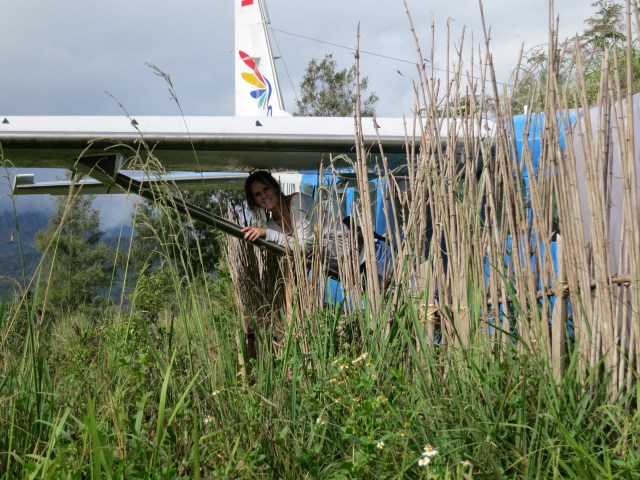
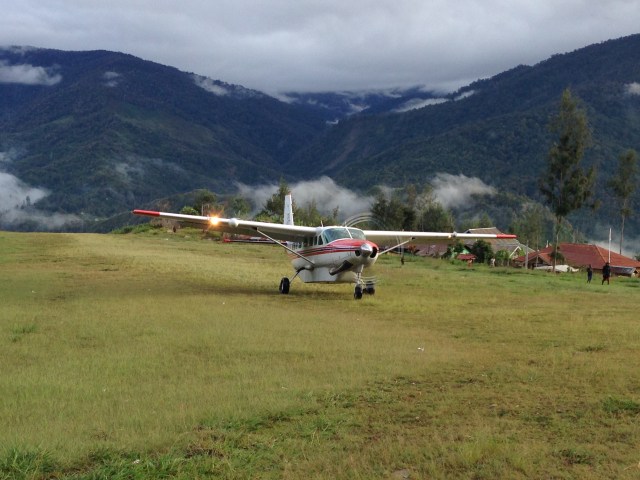
Recently, two friends and I boarded MAF  (Missionary Aviation Fellowship) at the Timika Airport and headed to Pogapa for the weekend. MAF is a nonprofit organization dedicated to providing aid, relief, and mission projects to some of the world’s most isolated people. The organization uses Cessna caravan airplanes to transport food, medical supplies, building materials and other necessary supplies and equipment to remote villages. For a small fee of Rp750,000/flight (about US$68.00), the pilot will transport adventurous travelers from Timika to Pogapa, and then back to Timika.

Accompanied by boxes and bags chock-full of frozen chicken, bread, beans, flour, clothes, books, and toys for the village, we flew above the great and vast land of Papua. Rolling forest floors and meandering riverbeds continued beyond what our eyes could see. The most spectacular sight was flying within touching distance of an imposing sheer cliff. The same cliff where the crashed remains of a World War II U.S. military plane can be spotted by the discerning eye in the “Shangri-La” valley below.

After passing the cliff, the pilot turned the small plane into a wide-open valley, circled the village below, and then steered it toward nothing more than an elongated grassy patch. If that wasn’t nerve-racking enough, the landing strip was built with a drop-off at one end and a mountain slope at the other end. The landing took my breath away!

Our plane flying over Pogapa Village. The long strip in the heart of the village is the landing strip.

Our plane flying over Pogapa Village. The long, bare line running down the middle of the village is the landing strip.

Once we were on the ground, the men, women and children of Pogapa, and their long-time friend and advocate, John Cutts, warmly greeted us. Even a few visiting members of a distant tribe watched us fly in, but they chose to keep their distance and remained on the hill at the end of the landing strip.

People from all over the village lined up on both sides of the runway to welcome us to their home.

A group of villagers who came out to welcome us to Pogapa.

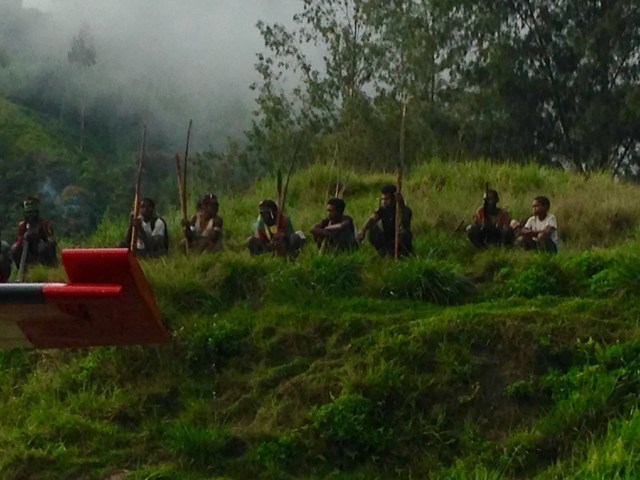
This group of men, from a neighboring village, watched the plane arrive, but kept their distance. They were dressed in tribal paint, wore headdresses, and carried bows, arrows, and spears. I was hoping to get a better picture of them, but they ran off before I could. Narelle took this picture before they ran off.

This group of men, from a neighboring village, crouched down on the top of the hill and watched us arrive. Dressed in tribal paint and headdresses, and carrying spears, I was hoping to get a better picture of them, but they jumped up and ran off when I started walking toward them. My friend, Narelle, took this picture just moments before they left.

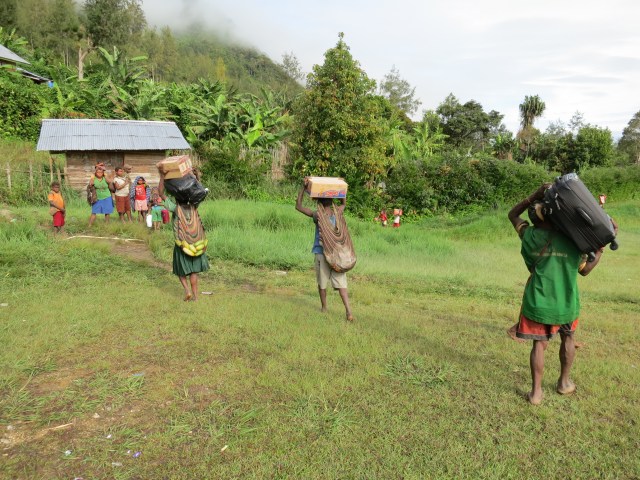
Women and children grabbed our bags and boxes of goods and took them to John's house for us.

Men, women, and children picked up our luggage, and the bags and boxes of goods that we brought with us, and carried them to John’s house where we stayed.

We thanked our helpers by giving them a bag of dry noodles to eat.

Narelle, Myriam and I thanked the people who carried our luggage by giving them bags of dry noodles (similar to “Itchiban” noodles that are available in the U.S.).

Our adventurous weekend in Moni land was filled with explorative walks around the village. The center of the village consists of the community church, a row of shops, traditional huts, wood plank houses, and vegetable gardens. Heavily used paths, leading in and out of the village, led us to the children’s school, a clinic, more huts and houses, more vegetable gardens, an incredible lookout point, and one of two recently crashed aircraft.

Villagers going about their daily activities.

A few villagers engaging in daily activities. During this trip, I learned that men carry bows and arrows, not for hunting, but for the sole purpose of being prepared for conflicts, battles, and tribal wars that can erupt at any given moment.

A man dressed in a traditional gourd.

A Moni man dressed in a koteka (a penis gourd). The length of the koteka indicates a man’s rank and influence. This man is viewed as a “Big Banana” in the village. He was excited about having his photo taken, and happily posed for several photos before continuing his walk up the landing strip.

A mini woman with her hands cupping her head. Notice finger

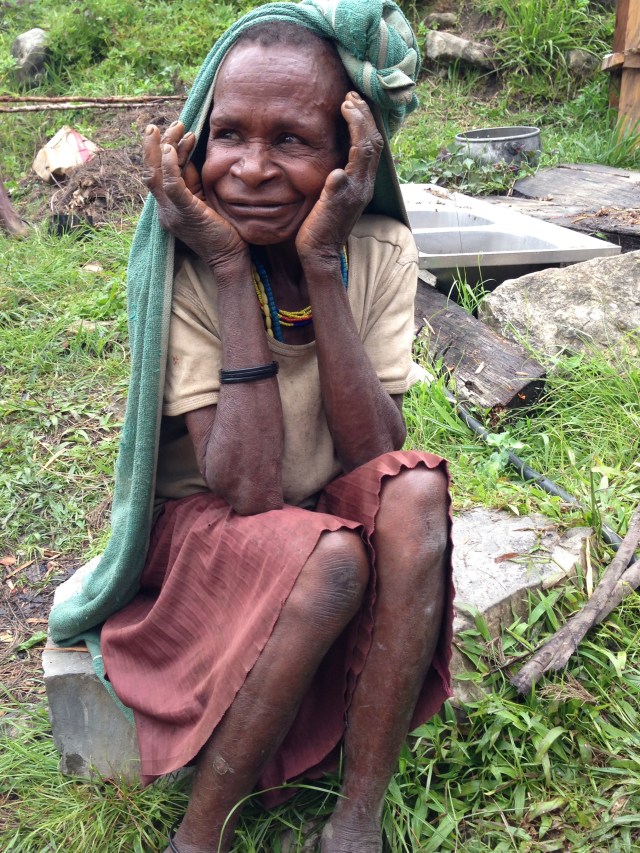
A Moni woman cupping her head with her time-worn hands. The top of her right pinkie finger is missing because she removed it during a mourning ritual after losing a loved one. When preforming the ritual, a finger is tightly bound with string and then amputated at the knuckle by a hatchet-like tool. The finger is then buried whole, or dried and burned. The ritual symbolizes the pain and suffering of losing a loved one.

Two

Two Moni boys peeking through a fence. The orange colored hair, on the boy standing to the left, indicates a protein deficiency. The people living in Pogapa have limited sources of protein because they are a tribe of gardeners and gatherers. With John’s help, rabbit breeding was recently introduced to the village to give them a healthy, sustainable source of protein.

Aircraft

This aircraft (not owned or operated by MAF) crashed upon landing. The pilot had very little experience landing on the difficult landing strip and wasn’t prepared to make his first solo trip into the village. The pilot and his passenger survived the crash, but the aircraft received substantial damage. The other aircraft (which crashed under similar circumstances) was removed from the village last month.

Martha and her garden.

Martha and her prolific garden!

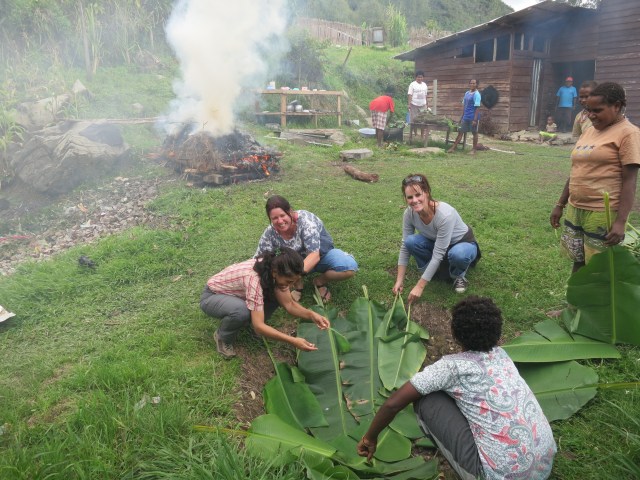
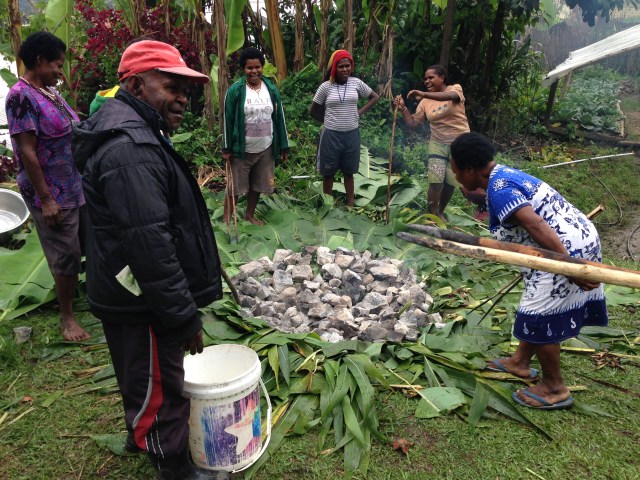
We were graciously invited to attend a kindergarten graduation on Saturday morning and church services on Sunday morning. After Sunday’s church service, we assembled at the church leader’s house to participate in a traditional saigia. A saigia is a feast where food is placed in a shallow pit lined with banana leaves and cooked to perfection with red, hot rocks. Our feast included chicken, a mixture of native greens, and garden-fresh squash.

The church building.

The village church. It also serves as a community hall where other activities, including school graduation, take place.

Women and children socializing after church.

Women and children socializing after church.

Smoke billowing

The saigia began with a raging, hot bonfire to heat the rocks that were used to cook the food. John’s house (where we stayed) can be seen in the background.

While the rocks were heating, Myriam, Narelle and I helped the women line the pit with banana leaves.

While the rocks were heating, Myriam, Narelle and I helped the women line the pit with banana leaves.

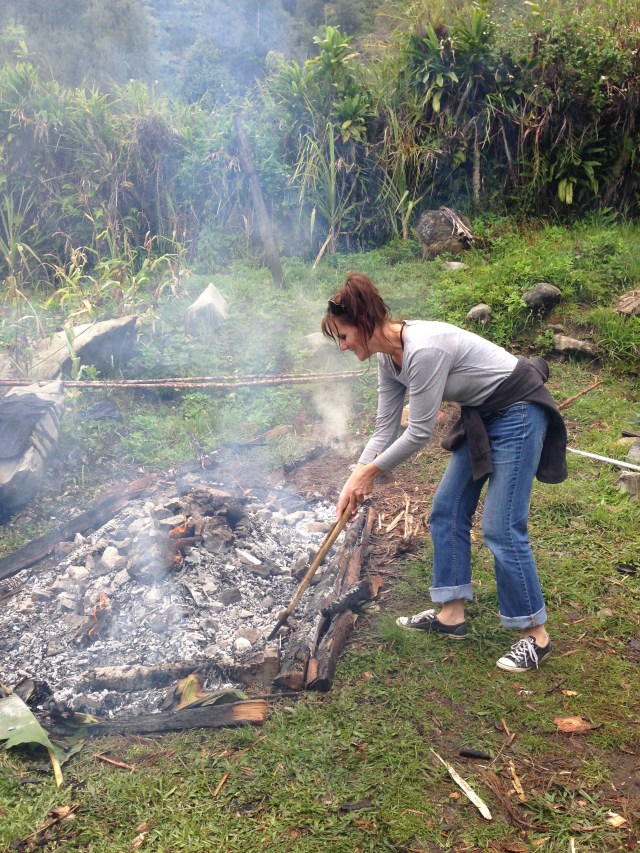
When the rocks were thoroughly heated, a group of men and women used split sticks to move them over to the pit.

When the rocks were thoroughly heated, a group of men and women used split sticks to move them to the cooking pit.

Filling the pit with hot rocks.

I even tested my skills of manipulating a split stick to pick up and move a few rocks.

Filling the pit with fresh greens.

Another layer of banana leaves was placed over the hot rocks. After the rocks were covered, the women threw a heaping mixture of edible greens over the leaves.

Placing chicken and squash on top of the greens.

Whole chickens and quartered squash were placed on top of the greens.

Another layer of hot rrocks and banana leaves was placed on top of the food.

A final layer of banana leaves and hot rocks were placed in the pit before the vegetables and the meat were left to cook for several hours.

Our lunch!

Our lunch!

John

John Cutts is a second-generation missionary in Papua’s highlands. In 1942, his parents, Bill and Gracie Cutts, were one of the first white people to arrive in the interior of Irian Jaya as missionaries for The Christian and Missionary Alliance. John was raised with the Moni people from infancy, and continued the family’s legacy by raising his own children on the mountain. In addition to carrying on the ministry, John serves as their friend, teacher, brother, and advocate. He and his wife created a non-profit organization, Village Heartbeat, to help meet the social, educational, health and religious needs of the Moni people.

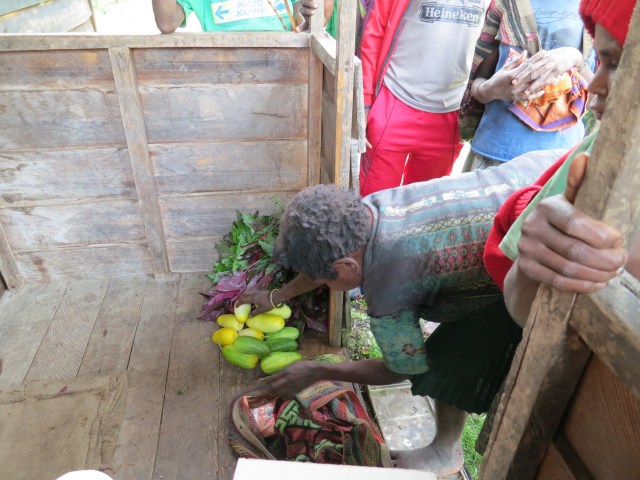
When we weren’t immersing ourselves in the day-to-day activities of the native culture, we were buying produce (avocados, heirloom tomatoes, numerous varieties of lettuce, cucumbers, radishes, and sweet potatoes) from local gardeners at John’s front door, while enjoying Myriam’s constant flow of hot Columbian coffee on the veranda at his backdoor. The mass collection of vegetables that we purchased were packed in boxes and taken back to jobsite. It was a special treat to make garden-fresh guacamole for Chris and the girls when I returned!

A Moni woman setting out lettuce and cucumbers for us to look at and buy.

A Moni woman setting out cucumbers for us to look at and buy.

A Moni woman setting out freshly picked heirloom tomatoes from her garden.

Another Moni woman setting out freshly picked heirloom tomatoes for us to look at and buy.

View from John's veranda.

The incredible view from John’s veranda.

We woke up early Monday morning to watch the sunrise and to pack our bags for our return flight home. The weather is always unpredictable in the mountains, so it was comforting to hear the Cessna’s single-engine turboprop dutifully spinning in the distance; and then, moments later, to see it clear the mounting clouds. We watched the small plane precariously fly toward the landing strip and then expertly set its wheels on the rough terrain. A perfect landing.

Plane flying in to pick us up.

Our pilot, Dennis, returning to pick us up.

Plance landing

The aircraft arriving at the end of the landing strip.

I was already boarded and ready to go, but everyone else was still taking pictures and saying good-bye. I was anxious about getting out of the village because I had to go to Jakarta the next day to have pages added to our passports before our trip home.

Making sure our backpacks were onboard before saying our final goodbyes to John and his Moni family.

Posted in Villages | Tagged , , , , , , , | 7 Comments

Komoro Art and Culture Program

The spirit of the Komoro people enveloped the local community last month with its annual art and culture program. The fervent sound of handcrafted wooden drums penetrated the air, while artisans, with painted torsos and feathered headdresses, manipulated primitive tools to create unique works of art. A collection of authenticated carvings made by village artificers, including life-sized totems, sago bowls, spears, drums, and shields, were displayed for people to admire and purchase.

The visiting tribesmen spent most of their time at MZS and YPJ where they educated the young students on their way of life. Through storytelling, dance, music, and art, the students learned about the unconventional culture that surrounds them. A culture that is slowly changing, but still trying to hold on to its rich ancestral roots.

Ally and the other middle school students dancing with the Komoro men and women.

Ally and some of the other middle school students dancing with the Komoro people. Photo courtesy of Dr. Muller.

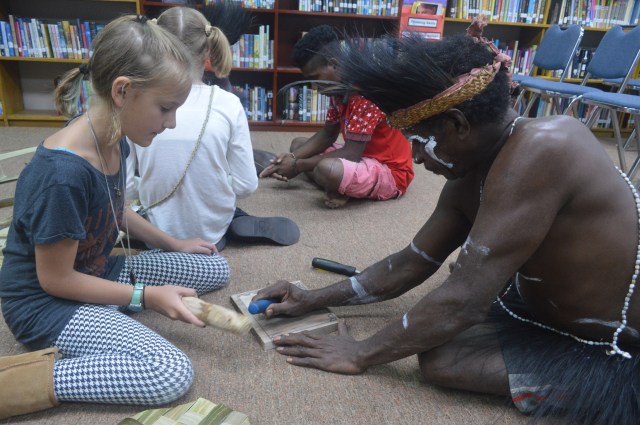
A Komoro tribesman teaching Kylee how to carve wood. Kylee carved a casssowary (a large, mean, flightless bird native to Papua) on her board.

A Komoro tribesman teaching Kylee how to carve wood. She carved a casssowary (a large, mean, flightless bird native to Papua) on her wooden plaque. Photo courtesy of Dr. Muller.

The climax of the program took place at the Lupe Lelah Club during Sunday brunch. Performers entertained the crowd with traditional drumming and dancing, while women, dressed in thick grass skirts and plaited tops, pressed sago palm shavings through crude wooden screens to make an edible paste. When brunch was served, traditional food (including the sago paste, grubs and tambelos) was offered to anyone brave enough to test their culinary limits.

A video of Kylee eating a tambelo:

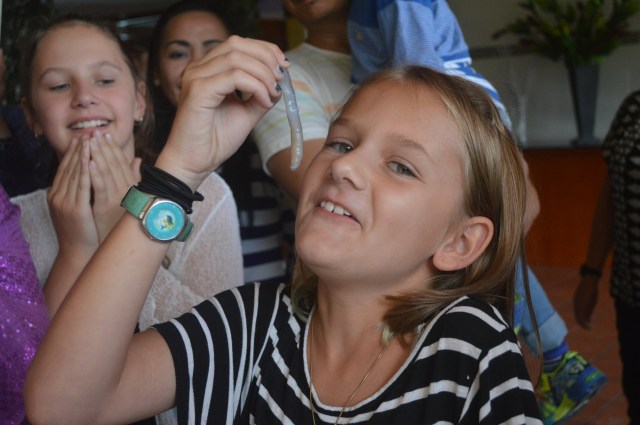
The 5 Stages of Eating a Tambelo

The five states of eating a tombelo: Stage 1 - Picking up a live tomebelo and accepting the dare of eating it.

Stage 1 – Picking up a live tambelo and accepting the dare of eating it. Photo courtesy of Dr. Muller.

Stage 2 - Felling the excitement of the moment!

Stage 2 – Feeling the excitement of the moment! Photo courtesy of Dr. Muller.

Stage 3 - Taking a good look at the wiggling tombelo and having some serious second thoughts.

Stage 3 – Taking a good look at the tambelo and having some serious second thoughts. Photo courtesy of Dr. Muller.

Stage 4 - Getting it close to your mouth and letting it wiggle on your lips.

Stage 4 – Moving the tambelo close to your mouth and letting it wiggle on your lips and tongue. Photo courtesy of Dr. Muller.

Stage 5 - Getting it in your mouth and down your throat as quickly as possible.

Stage 5 – Getting the tambelo in your mouth and down your throat as quickly as possible. Photo courtesy of Dr. Muller.

After the last tambelo was eaten, people settled back down in their seats to watch the much-anticipated drum skinning performance. Human skin was broken, blood was collected and a drum was skinned. After twenty-minutes of drying in the hot sun, the drum was brought back in for its maiden performance.

Herman (the tribesman on the right) cut is left arm and collected blood in a container (about 11/2-2ounces). The blood was mixed with powder and then the pasty mixture was rubbed around the base of the drum. A dry lizard skin was placed on top and secured with stands of bark.

One of the tribesman cut is arm and collected blood (about 2 ounces) in a small container. The blood was mixed with powder and then rubbed around the base of the drum before a dry lizard skin was placed on top and secured with thin stands of bark. Photo courtesy of Dr. Muller.

The two-week event was an impressive exhibition of Komoro heritage and culture. Presented by Dr. Kal Muller, French language enthusiast turned self-taught anthropologist turned art dealer extraordinaire, the program was designed to keep the Komoro woodcarving tradition from dying out. With his hard work and determination, it’s flourishing.

Dr. Kal Muller, flanked by a Komoro man and a Komoro .

Dr. Kal Muller, surrounded by Komoro people. Photo courtesy of Dr. Muller.

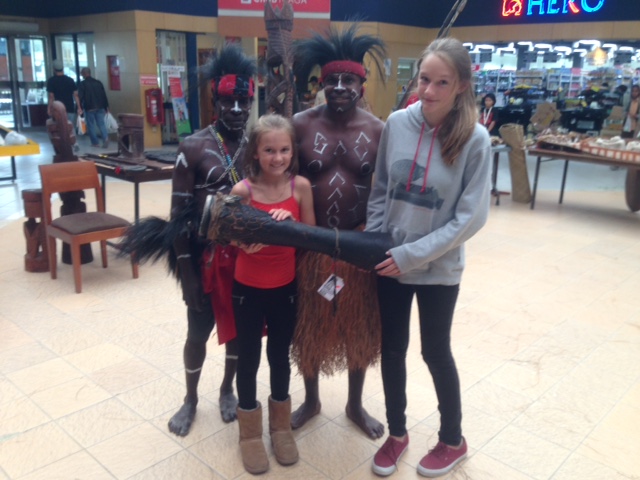
Ally and Kylee with two of the Papuan men who were involved in the drum skinning presentation. The man of the left is Herman, one of Dr. Muller's biggest supporters. The girls are holding the drum, which we were able to purchase, that was used in the presentation

Ally and Kylee with two of the Papuan men who were involved in the drum skinning performance. The man on the right is Herman, the one who collected the blood and completed the drum making process. He is one of Dr. Muller’s biggest supporters. The girls are holding the drum (which we were lucky enough to purchase) that was skinned and finished at the brunch performance .

Posted in Ally Rose, Kylee Rose, Tembagapura | Tagged , , , , , , , , , , , , , , | 4 Comments

Lost in Translation – Part III

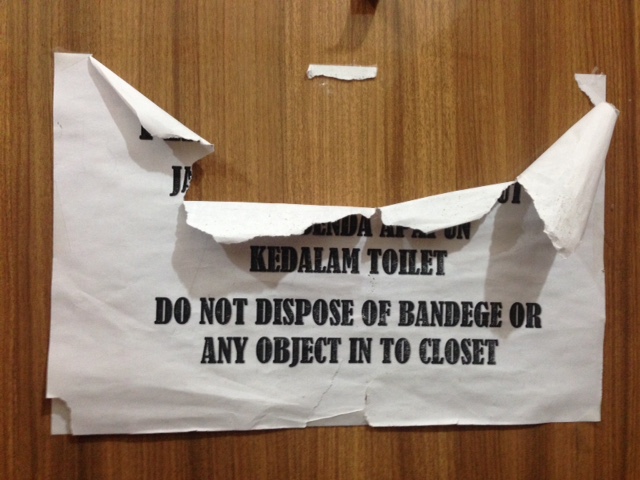
This sign was posted in a bathroom in Bali. The person who wrote it used the proper use of “toilet” in the Indonesian section, but, mistranslated it to “closet” in the English section.

More wrapping paper (Made in China) that I purchased from jobsite. At first, it looks like wrapping paper for a birthday present, then you notice the written message. Is it for a birthday or for Christmas? I’m so confused!

The department store just received a new shipment of coffee mugs. I BELIEVE someone should have used spellcheck before authorizing the final production of this mug.

These mugs (Made in China) were still sitting in the packing box when I picked one up and spotted the blunder. I BELIEVE someone should have used spellcheck before authorizing the production of the mugs. How can the typist get it right the first time, but not the second time?

The product description on the bottle states that it is “Honeydew” flavored green tea; however, the image on the label is that of a cantaloupe. FYI – the Indonesians refer to cantaloupes as “rock melons.”

Indonesian math must be a little different than the math that I'm familiar with.

Indonesian math must be a little different than the math I know.

This is written on the back of a toy farm set that is stocked on the shelves at the department store. The message is so slaughtered that I can't even begin to understand, or even guess, what the intended message is supposed to be.

This is written on the back of a toy farm set (Made in China) that I found on the shelves at the department store. The message is so slaughtered that I can’t even begin to understand, or even guess, what the intended message is supposed to be.

Posted in Funny | Tagged , , , , , , , , | 1 Comment

Flight #GA652

images

The worst part of travel to and from Tembagapura is Flight #GA652, from Denpasar-Bali to Timika. It leaves at 1:50am and arrives in Timika three-hours and forty-minutes later at 6:30am (there’s a one-hour time difference). The grueling, red-eye flight torments us with an indescribable amount of physical and mental exhaustion.

With purpose and skillful planning, we intentionally avoided this flight during our last three trips out. Instead of flying to destinations north of us, which requires travel to and from Bali, we flew to destinations south of us (Australia, New Zealand, and New Caledonia), which offers a merciful daytime flight through Cairns on the company airline. However, it was only a matter of time before we had to submit ourselves, once again, to the devil in the sky.

The girls and I boarded Flight #GA652 last week when we returned from a quick, three-day vacation to Bali. A week later, the painful memory of the flight has eased just enough for us to admit that three days of shopping, surfing, and spending time with friends was worth enduring its brutal schedule.

The girls and their instructors walking down the beach.

Ally’s good friend, Summer, left jobsite last week to begin a new adventure – boarding school in Australia. Before heading home to New Zealand for a short break, and then on to school, she and her mom made plans to spend a few days in Bali, and invited us to join them. The girls all agreed that an afternoon of surfing was a priority. This is a picture of the girls and their instructors walking up Kuta Beach.

Pic

The girls applying sunscreen and listening to safety instructions.

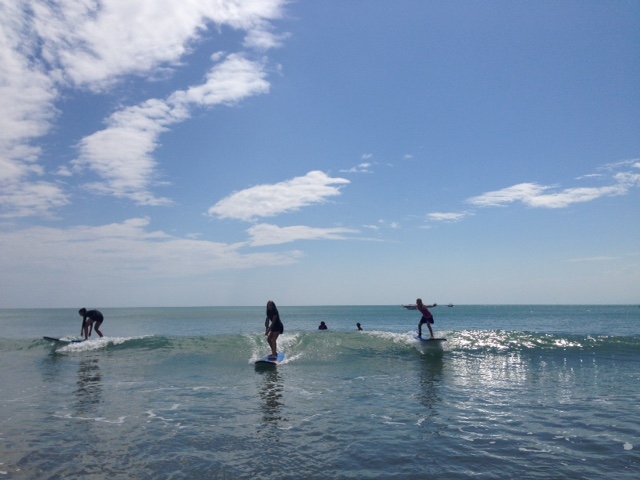
Summer (left), Ally (middle), and Kylee (right) on their surfboards. All three girls caught every single wave they attempted to ride. Best surfing ever!

Summer (left), Ally (middle), and Kylee/”Little Bethany” (right) on their surfboards. The girls caught every single wave they attempted to ride. It was, by far, the best surfing experience of their lives!

Posted in Ally Rose, Kylee Rose, Tembagapura, Vacation | Tagged , , , , , , , | Leave a comment

5.5lbs of Red Vines

This tub of American goodness was hand transported all the way from the U.S. mainland to the Papuan rainforest for the purpose of being auctioned off at a school fundraiser that was held last weekend. As soon as Chris and I saw it sitting on the live auction table, we (okay, mostly I) knew that we had to get it.

Easily justified by the fact that it was the only existing tub of Red Vines on the island (and quite possibly in the entire country of Indonesia; or, even all of Asia, for that matter), we couldn’t resist. We paid an absurd amount of money for it, but, suffice it to say, it was worth every rupiah (especially, after seeing the girls’ faces when they saw it). Plus, the money went to a good cause.

Food for the soul!

Food for the soul!

Posted in Tembagapura | 2 Comments

New Caledonia

Thousands of miles from France, a French territory rests on an archipelago in the sun-drenched South Pacific seas. New Caledonia, more commonly known to the locals as Nouvelle-Calédonie, is best described as a Melanesian island with a touch of Parisian sophistication. It’s an unusual fusion of culture that is unique to that set of islands. We spent six days in the capital city of Noumea, a quiet town that sits on a large peninsula with the world’s largest lagoon, picturesque bays, and sandy beaches.

view from hotel balcony

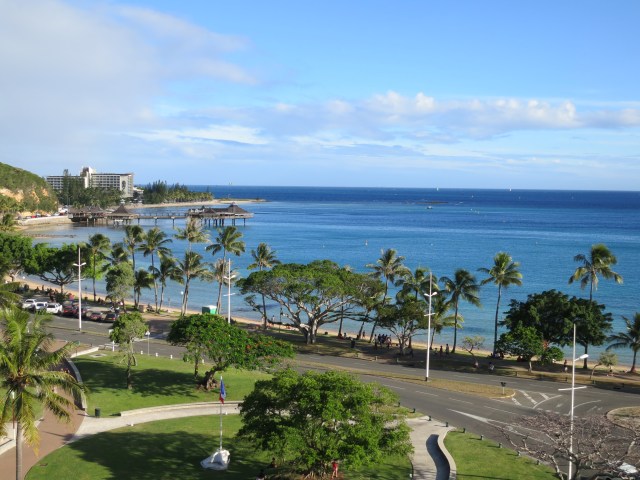
An ocean view of a coastline in Noumea.

girls

The girls standing in front of the French flag.

Where there's a tree, there will be two girls.

Where there’s a tree, there’s two girls. There are no climbing trees at jobsite, so the girls are always on the lookout for a tree to climb when we are off site.

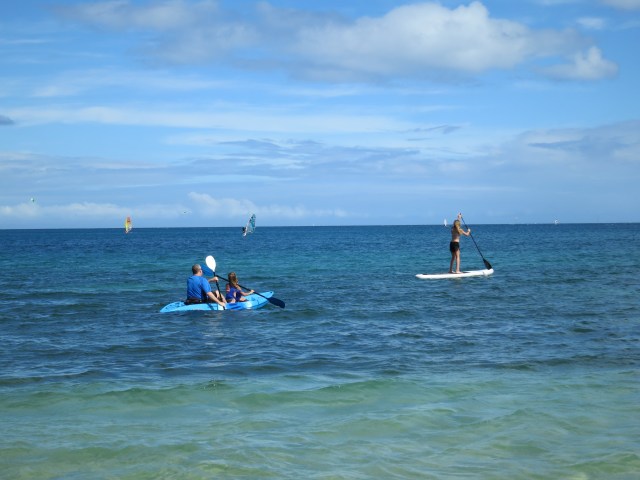
Chris and Kylee riding in a sea kayak, and Ally paddling on a paddle board, in Noumea

Chris and Kylee riding in a sea kayak, and Ally paddle-boarding in Noumea.

swimming

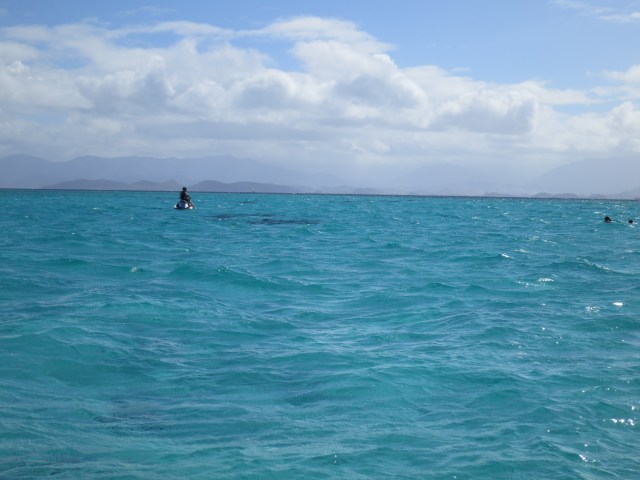
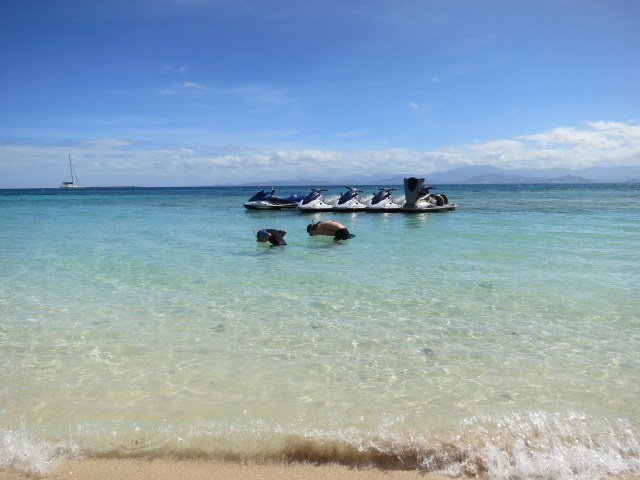
While in Noumea, we took a half-day jet skiing tour to two outlying islands. On the way to the first island, we stopped to take a short break and to let the girls swim in the vibrant turquoise waters.

stunning

The colors of the sky and ocean in this picture are more true to what we saw and experienced. Our camera rarely captures what our eyes see. Either way, the views are nothing short of stunning! The man on the jet ski was our tour guide.

island

We took an hour break on this small, uninhabited island, which gave us plenty of time to walk around it, swim, snorkel, and enjoy the scenery.

Snorkeling during an island break

Ally and Kylee trying to spot fish.

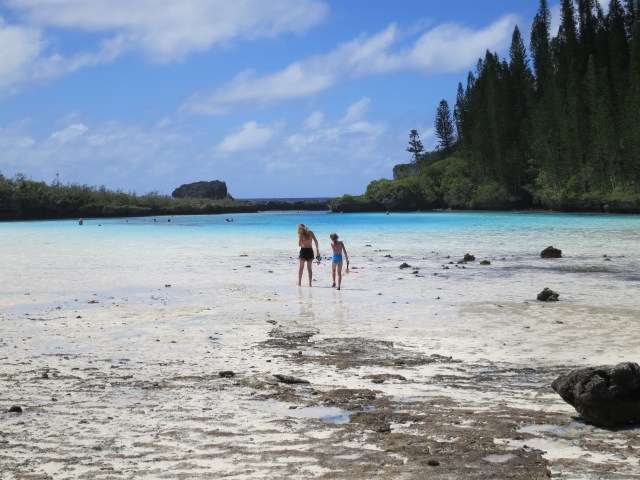
Other than the outstanding food (the Noumeans are culinary artists), our most defining time in New Caledonia was a day trip to Île des Pins (Isle of Pines); a small island 110km southeast of Noumea. Imagine a fragmented piece of Alaska in the warm, tropical waters of the Coral Sea. If that doesn’t sound magnificent enough, imagine white sandy beaches and natural pools of seawater where the spectacular display of the Northern Lights radiate from beneath the water’s surface. Its raw beauty was breathtaking!

We took a two-and-a-half hour ferry ride from Noumea to the island. Our tour guide, Jeankri, took this photo right after we arrived on the island and met up with him. His calm, relaxed demeanor exemplified the locals perspective of life on the island -

We took a two-and-a-half hour ferry ride from Noumea to the island. Our tour guide, Jeankri, took this photo of us right after we arrived on the island. Jeankri’s calm, relaxed demeanor exemplified the locals’ perspective of life on the island – “A quoi bon le compter, il ne s’arrêtera jamais.” Which means, “Why measure the time, it will never end.”

Beauty

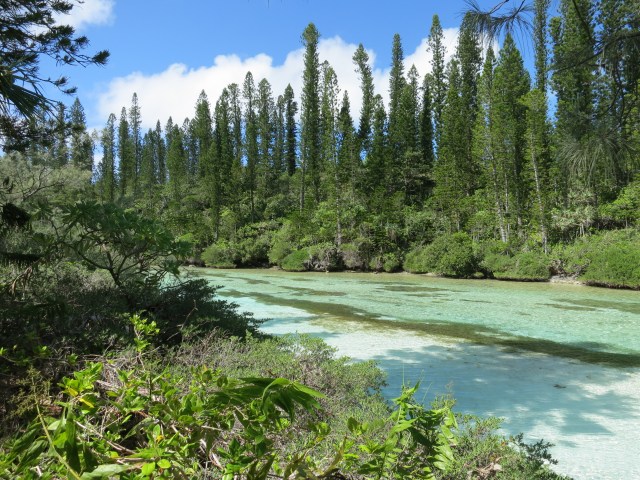
Our first stop was to Baie de Oro; revered as one of New Caledonia’s most treasured destinations. With Araucarua pines soaring above pristine sandy beaches, it is one of the most beautiful places in the south-pacific. FYI – Araucarus pines are the living Christmas trees that you can buy at Home Depot or Walmart during the holidays. Here, in their native environment, they grow to be massive and beautiful.

Posing for a picture in a sea-water river.

Jeankri took another photo of us walking through the sea-water river pictured above.

Girls snorkeling

After a short walk up the river and through a forest trail, we reached earth’s sweet spot – Baie de Oro’s la Pascine Naturelle. The large body of crystal clear water, embedded in coral, is the islands best spot for snorkeling. It is filled with an extensive variety of colorful fish, coral, and other sea creatures.

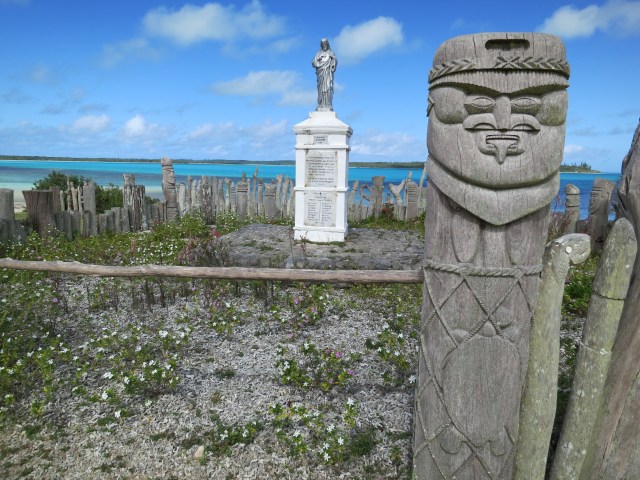
The statue of St Maurice (in the background), commemorates the arrival of the first missionaries on the island. The statue is surrounded by hand carved totems made by the numerous clans of the island.

After leaving Baie de Oro, we went to La statue de St. Maurice. The statue of St Maurice (in the background), commemorates the arrival of the first Christian missionaries to the island. The statue is surrounded by hand carved totems made by the numerous clans of the island.

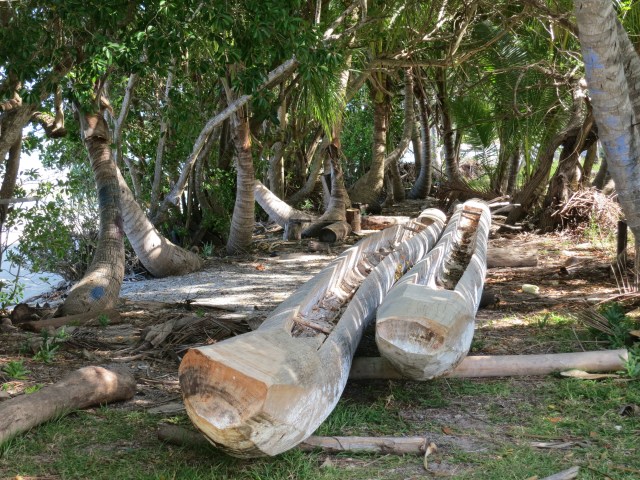
An alcove near the Bae de Saint-Joseph, where locals continue to build traditional canoes.

A  naturally sheltered alcove where locals continue to build traditional boats.

Kylee has a cute habit of holding her pointer finger up and saying,

Kylee has a funny habit of holding her index finger up and saying, “Jus’ sec”, if she needs to pause. We found her patron saint in the Notre-Dame de l’Assomption church. The church was built in 1860 by French prisoners, and is still used today.

nataiwatch

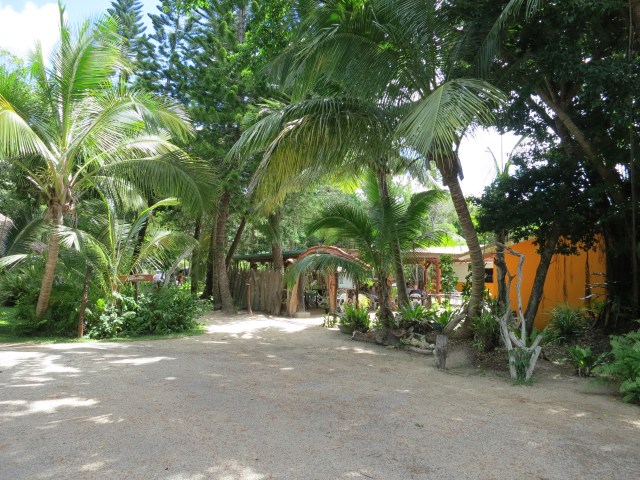
Jeankri recommended Kunie Kaa, at Nataiwatch, for lunch. It’s outdoor, sand in your feet setting is known for serving “plats du jours,” which means dish of the day.

escargot

Every day, the chef gets up early to catch and procure fresh ingredients for the day’s menu.  With the ingredients in hand, he returns to the kitchen to prepare breakfast, lunch, and dinner. The only standard (and best) part of the menu is escargot, which is made from a special variety of snail that only lives wild on that island. These snails, living or cooked, can’t be transported off the island. High penalties are given to those who try to take the snails (or the empty shells) with them.

bae

Our last stop, before departing Ile de Pins, was to Baie de Kanumera for more swimming and snorkeling.

Kylee

Kylee, our snorkeling aficionado, has come a long way from her first snorkeling adventure in Hawaii. She wouldn’t even get off the boat because she was afraid of running in to the people who stole Nemo.

After leaving New Caledonia, we flew to Brisbane to visit Australia’s Gold Coast and Sunshine Coast. We spent four days in Byron Bay and five days in Noosa Heads. It was all about shopping, surfing, walking along beaches, hiking through national forests, exploring farmers’ markets, eating good food, and getting two black eyes*. The simple things.

Byron Bay

The best thing about the sand in Byron Bay, other than its soft, powdery texture, is that it squeaks.

Pic

Chris and the girls taking a break from the squeaky sand.

minyon falls

A thirty-minute drive from Byron Bay, on a single track road with hairpin turns, is Minyon Falls, a scenic waterfall with a multitude of hiking trails around it.

hike

We left the observation deck (viewing the falls from the top) and began our hike along the lower falls trail. Ally instinctively started carrying our picnic bag like Papuan women carry their nokens (traditional bags).

hike

The girls crossing a river.

Selfie

Yet another one of Ally’s wildlife selfies. This time, it was with a bush turkey. They are found everywhere along Australia’s east coast, digging up groomed and manicured landscaping. This one was on its way to the ladies room when Ally took her photo before she attacked her ankles.

*Ally and Kylee rented surfboards in Noosa Heads the day before we left. Unfortunately, Ally’s surfboard flipped out of the water and hit Chris in the face. He received a gnarly laceration on the bridge of his nose and two black eyes. Immediately after muttering an expletive, he kept a pretty good sense of humor about it.

Posted in Ally Rose, Kylee Rose, Vacation | Tagged , , , , , , , , , , , , , , , , , , , , , | 9 Comments

We’re on Vacation!

Sorry-out-to-live-be-back-soon

I’ll be back in two weeks to post more pictures and stories of our family’s adventures in Indonesia (and beyond)!

Posted in Uncategorized | Leave a comment

The Six Smells of Tembagapura

Before moving to Tembagapura, I imagined the Papuan rainforest saturated with exotically sweet and sultry smells. I was wrong. In fact, the smell of Tembagapura is limited to six distinct aromas. The most prevalent aroma is damp terra firma, which is often punctuated by a pop of diesel fuel, cigarette smoke, body odor, juniper, and/or campfire. The unwavering combination of these odors creates a smell that is exclusive to jobsite.

WordPress just installed a new program in its operating system that digitally transmits synthetic sensory signals that drive human odor perception. The signals stimulate the brain into believing that it is smelling what it is seeing. It’s an incredible way of providing readers with a truly unique olfactory experience.

The program includes a vast database of more than fifteen-thousand hyper-sensitized aromatic images for users to incorporate in their blogs. To experience the six smells of Tembagapura, simply click on the images below.

images-1 images-1 images-1 Unknown images-1 images-1

Posted in Tembagapura | Tagged , , , , , , , , , , , , | 6 Comments

Another Day, Another Strike

PTFI was on the cusp of recovering from last October’s strike when a small number of Tujuh Suku, the seven tribes, blocked the access road to the underground mine and the open pit with a piece of heavy equipment early Monday morning. Within hours, hundreds of tribal employees joined the blockade. According to Kompas.com, their demands include seeing the company impose sanctions on employees who supported the last strike, and rewarding the seven tribe workers who did not support the strike.

Yesterday morning, one-hundred and fifty members of the Indonesian police arrived at jobsite in full riot gear. With their shields in hand, they walked through the blockade, opening it up for employees who were wanting and waiting to return to work. Just another day at PTFI.

My personal opinions and views do not reflect the views of Freeport-McMoRan Copper & Gold Inc. or any of its subsidiaries, affiliates, business partners or related business entities.

Posted in Tembagapura | Tagged , , , , | Leave a comment